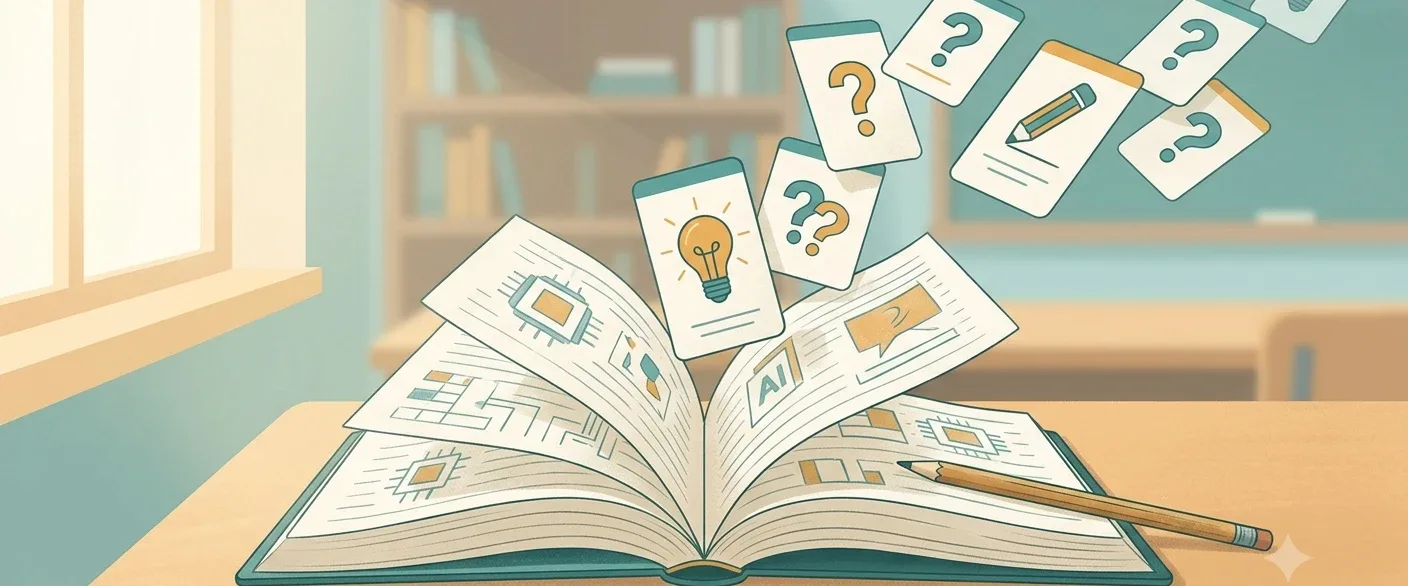
Google started rolling out Gemini in its Classroom software to students of every age on Monday, August 10. K-12 and university learners can now turn their own coursework into flashcards, practice quizzes and study guides. Until now these tools were open only to teachers and to students aged 18 and over.
The web version began rolling out on August 10, and the mobile version follows on August 17. Google says the feature reaches schools worldwide, in every language Classroom supports where Gemini is already available. It works for institutions on the Education Fundamentals, Standard and Plus editions of Google Workspace.
Inside a class, students open a Gemini tab and pick a prompt. A box then asks them to choose their class and assignment, and Gemini pulls in the assignment title, the teacher's instructions and the attached course materials on its own. The idea is to keep the tool tied to the lesson rather than acting as an open-ended chatbot. Students who also have Gemini Notebook, the tool formerly called NotebookLM, can sync a teacher's files to make study guides, audio overviews and infographics.
None of this switches on by itself. A student only sees Gemini if an administrator has already turned on Gemini in Classroom, the Gemini app and Gemini Notebook. The controls are on by default for teachers and students, but admins can switch the feature off for anyone under 18 by moving those users into a separate group. Google says the education version does not use student data to train its models and that no human reviewer reads it. The company also warns that the AI can make mistakes and that students should check its answers.
The step extends work Google began with teachers, who got Gemini to help plan lessons. It then opened the study features to higher-education students on December 1, 2025. Classroom now reaches about 150 million users, so putting a chatbot in front of children marks the widest test yet of AI aimed straight at learners rather than staff.
Beyond the rollout itself, the harder question is what daily AI help does to young minds. Researchers at Australian universities warned in March that unstructured use risks what they call cognitive atrophy, the slow decline of memory and reasoning when students hand their thinking to a machine. "The cognitive offloading from human to AI is especially risky for school students, who are building the foundational knowledge and skills that enable both schooling and lifelong capacity for learning," said Professor Leslie Loble of the University of Technology Sydney in a report she co-authored. Her co-author, University of Queensland cognitive psychologist Professor Jason Lodge, added that "school years are critical for building the memory stores and cognitive foundations that last a lifetime."
Whether Gemini helps or hinders will depend less on the software than on how teachers frame its use. Flashcards and quizzes push students to recall and test themselves, which supports learning; a tool that writes the answer skips the struggle that builds it. The thing to watch now is how schools set the guardrails, and whether Google's admin switches and its "review the outputs" reminder are enough once tens of millions of children start using it every day.